


Understanding Protection Circuits In Everyday Electronics
In our previous blog, “Why Electrical Protection Is No Longer Optional,” we explored how modern electrical systems are increasingly exposed to voltage fluctuations, overload conditions, and unstable power environments. As our dependence on electronics continues to grow, protection is no longer limited to industrial systems alone—it has become essential in everyday appliances and household equipment as well.
From refrigerators and washing machines to water pumps, televisions, and air conditioners, almost every electrical device today relies on some form of protection circuit to operate safely and reliably. These circuits work silently in the background, constantly monitoring electrical conditions and preventing damage before it occurs.
But what exactly are protection circuits, and why are they so important in modern electronics?
What Are Protection Circuits?
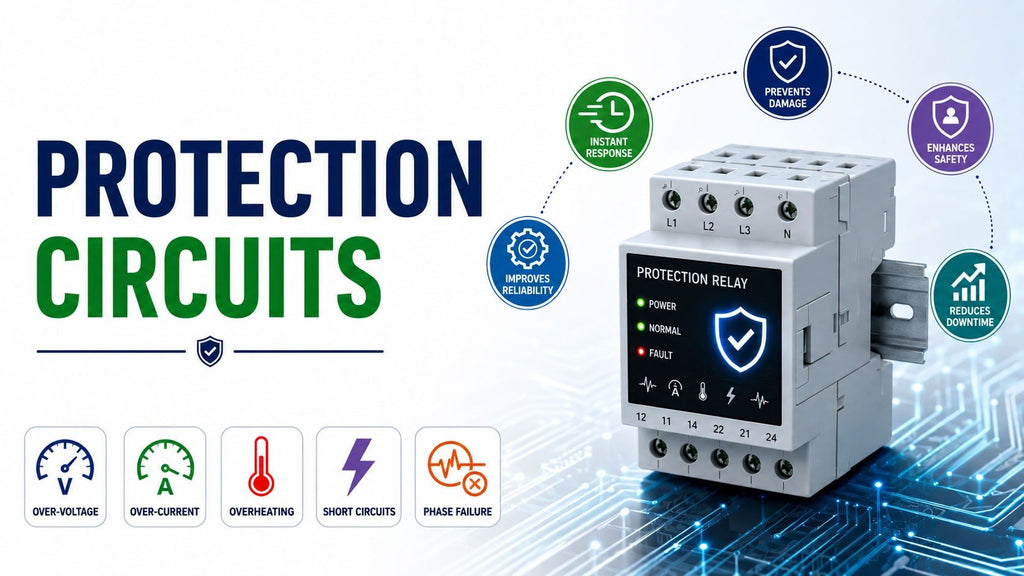
Protection circuits are specialized electronic systems designed to safeguard electrical equipment from unsafe operating conditions. Their primary role is to detect abnormalities such as excessive voltage, overload current, overheating, short circuits, or phase failure and respond immediately to prevent damage.
Unlike basic switches that only turn equipment ON or OFF, protection circuits actively monitor how a device behaves during operation. When abnormal conditions are detected, they either disconnect the equipment, reduce stress on the system, or trigger automatic corrective actions.
These circuits are now an integral part of modern electronics because electrical conditions in real-world environments are rarely stable.
Why Everyday Electronics Need Protection?
Many people assume electrical protection is only necessary for heavy industrial machinery. In reality, household appliances face similar risks every day.
Power fluctuations can damage compressors inside refrigerators and air conditioners. Low voltage conditions force motors to draw excess current, generating heat and reducing lifespan. Sudden power restoration after an outage can place immense stress on sensitive circuits. Over time, these repeated stresses gradually weaken components—even if the appliance appears to function normally.
Protection circuits help prevent these hidden failures by ensuring equipment operates only within safe electrical limits.
Common Types of Protection Circuits
Modern electronic systems often combine multiple layers of protection depending on the application.
- High and Low Voltage Protection: Voltage protection circuits disconnect equipment whenever supply voltage rises too high or drops below safe levels. This prevents overheating, insulation damage, and malfunction of sensitive electronic components. In areas where voltage fluctuations are common, this protection becomes critical for appliances such as pumps, refrigerators, televisions, and industrial motors.
- Overload Protection: Overload protection monitors the amount of current drawn by a device. If the current exceeds safe operating limits for an extended period, the circuit interrupts power supply to prevent overheating or burning of the motor or internal wiring. This feature is particularly important for pumps, compressors, and motor-driven systems that operate continuously.
- Dry Run Protection: Dry run protection is commonly used in water pumps and irrigation systems. When a pump runs without water, friction and heat increase rapidly, often causing severe motor damage. Dry run protection circuits detect abnormal current behavior associated with no-water conditions and automatically switch OFF the motor before overheating occurs.
- Short Circuit Protection: Short circuits create extremely high current flow that can instantly damage equipment and create fire hazards. Protection circuits respond within milliseconds to disconnect the supply and prevent catastrophic failure. This is one of the most fundamental safety mechanisms in electrical systems.
- Phase Failure and Unbalance Protection: Three-phase systems require balanced voltage across all phases. If one phase fails or becomes unstable, motors can overheat rapidly and burn out. Phase protection circuits continuously monitor supply conditions and shut down the system whenever imbalance or phase loss is detected.
How Protection Circuits Improve Equipment Life?
One of the biggest advantages of protection circuits is that they reduce long-term electrical stress. Motors and electronic components last significantly longer when protected from unstable conditions.
Instead of waiting for damage to occur, protection systems act proactively:
- Preventing overheating
- Reducing excessive current draw
- Avoiding repeated electrical shocks
- Minimizing downtime
- Improving operational reliability
This preventive approach not only improves safety but also lowers maintenance and replacement costs over time.
The Shift Toward Intelligent Protection
Traditional protection systems relied heavily on mechanical relays and manual supervision. Modern electronics, however, are moving toward intelligent digital protection systems capable of real-time monitoring and automated decision-making.
Advanced protection panels and starters can now:
- Display voltage and current digitally
- Automatically restart after power restoration
- Monitor load behavior continuously
- Detect abnormal motor conditions instantly
- Automate ON/OFF operation using timers and sensors
These smart protection systems make electrical operation safer, more efficient, and less dependent on human intervention.
Protection Is the Foundation of Reliable Electronics
As electrical environments become more demanding, protection circuits are no longer optional add-ons—they are the foundation of reliable electronics. Whether in homes, farms, or industries, the safety and performance of electrical equipment now depend heavily on how effectively systems can respond to unstable power conditions.
At Gelco Electronics, protection is integrated into product design with the understanding that real-world electrical systems are unpredictable. Intelligent starters, control panels, and protection devices are designed not just to operate equipment, but to ensure it survives and performs efficiently under practical operating conditions.
Conclusion
Protection circuits play a crucial role in modern electronics by safeguarding equipment against voltage fluctuations, overloads, overheating, dry run conditions, and electrical faults. While these systems often remain unnoticed during normal operation, they are essential for ensuring reliability, efficiency, and long-term equipment life. As power systems continue to become more complex and sensitive, integrating intelligent protection into everyday electronics is no longer just a technical enhancement—it is a necessity for safe and dependable operation.


